By Joe Morin | April 6, 2025

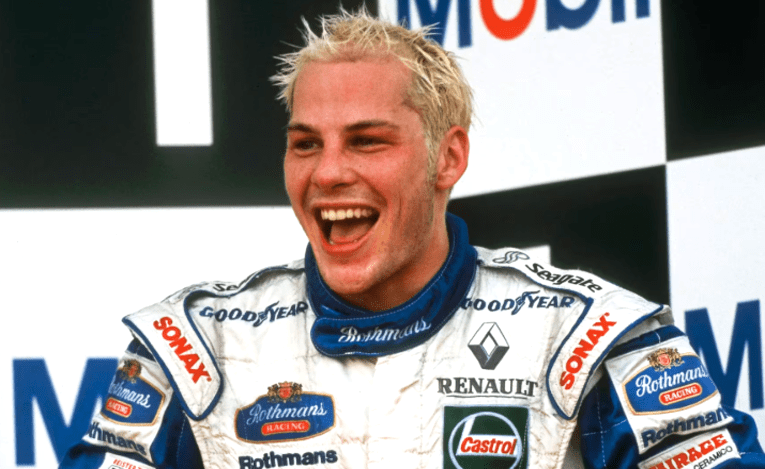
When Jacques Villeneuve arrived in Formula One in 1996, expectations were sky-high. He wasn’t just another rookie—he was the reigning IndyCar champion and Indianapolis 500 winner, stepping into F1 with immediate credibility and a famous last name.
And at first, he delivered.
Villeneuve nearly won the championship in his debut season and went on to claim the 1997 title with Williams F1 Team. But what followed is one of the more puzzling trajectories in modern Formula One history: a world champion whose career faded far quicker than expected.
So why did Villeneuve’s success prove so limited after such a strong start?
A Career Built on the Right Timing
Villeneuve’s early success was no accident—but it was heavily tied to circumstance. The Williams car he drove in 1996 and 1997 was widely considered the fastest on the grid. Designed by Adrian Newey, it gave Villeneuve and his teammate a significant performance advantage over most of the field. That doesn’t take away from his ability—he still had to deliver under pressure, especially in his fierce title fight with Michael Schumacher in 1997—but it does frame his success in context. When that advantage disappeared, so did his edge.
The Move That Changed Everything
The biggest turning point in Villeneuve’s career came after his championship win.
Instead of staying with a proven front-running team, he chose to join British American Racing (BAR), a brand-new outfit with long-term ambition but immediate growing pains. It was a bold move—but ultimately a costly one. BAR struggled badly in its early years, often stuck at the back of the grid. For a driver coming off a championship, it meant:
Fewer opportunities to fight for wins
Limited visibility at the front of the sport
A gradual loss of momentum
In Formula One, timing is everything. Villeneuve left a dominant situation for a project that simply took too long to become competitive.
Driving Style vs. Changing Era
Villeneuve was known for his aggressive, fearless driving style—something that worked brilliantly in the mid-1990s. But Formula One was evolving. As the sport became more technical and data-driven, drivers needed to adapt to increasingly complex cars, tire management strategies, and precision-focused racecraft. Villeneuve, by many accounts, was less adaptable in this new environment. His strength was raw racing instinct. The sport was moving toward calculated efficiency.
Reputation and Relationships
Another factor that can’t be ignored is Villeneuve’s personality. He was outspoken, independent, and often critical—traits that made him popular with fans but sometimes difficult within team environments. Over time, this affected his relationships with engineers, management, and decision-makers.
In a sport where collaboration is crucial, even small disconnects can have big consequences.
The Competition Got Stronger
Villeneuve’s peak coincided with a transitional moment in Formula One. By the early 2000s, the grid was stacked with elite talent and dominant teams. Michael Schumacher and Ferrari entered a period of sustained dominance, while teams like McLaren also raised their level significantly. Villeneuve, meanwhile, was stuck in midfield machinery. Even a driver at his best would have struggled to break through consistently in those conditions.
A Career of What-Ifs
It’s important to keep perspective. Villeneuve is a Formula One world champion—a rare achievement that places him among the elite drivers in the sport’s history. But his career still feels like a “what could have been” story.
What if he had stayed at Williams longer?
What if BAR had become competitive sooner?
What if he had adapted more effectively to the sport’s evolution?
Final Verdict
Jacques Villeneuve didn’t fail in Formula One—he peaked early and then lost the conditions that allowed him to succeed. His limited long-term success wasn’t due to a lack of talent. It was the result of timing, team decisions, and a rapidly changing sport that moved away from his strengths.
In another scenario, with different choices or circumstances, Villeneuve might have added multiple championships to his name. Instead, his legacy remains that of a brilliant but brief force at the very top of Formula One—a champion whose story could have gone much further.
Joe Morin is a regular contributor to The Sidearmer, specializing in Formula One coverage. He has been following Formula One and other forms of racing for over 30 years. He has even competed in the now-defunct Canadian Karting Championship, finishing second overall in 2008. This gives him a driver’s perspective, complemented by an analyst approach.
Morin also has experience in podcasting, having worked behind the microphone for over ten years and as a video and audio editor for The Gorilla Position and Turnbuckle Studios.
You can follow him on X @joemorinthef1guy.
 The Sidearmer